%20(4).png)

A few days ago, I had an extremely important but tough conversation with my family that I’m sure every student evades, but eventually has to. It provokes the taboo question for the indecisive:What do you want to do after you graduate?
There is a popular myth about artists and their living standards, that artists must choose between passion and prosperity—you cannot make a good living from making art. As someone who considers themself a creative and an artist, the “what are you going to do after you graduate” question is incredibly tough to answer, especially when the environment and policy are something you’ve been passionate about for years, but your degree and major lie in something else greater and more respected. Coming from an immigrant family with an extremely diverse background of experiences, where income and security are regarded as more valuable, I understand the priorities of a parent, whether it provides a ‘stable life’ or ‘adequate income,’ which is probably number one on everyone’s list.
The Crossroads of Intersectional Environmentalism
By June 2026, I will have a degree completed after spending four years at the University of Toronto Mississauga studying communications and environmental management. Growing up, I’ve been drawn to digital content creation. I've been invested in online spaces on social media, but being a creative and an artist has welcomed less attainable areas for a prospective future. However, this is not a piece on excluding artists and digging a hole for dreams, but rather more about how there’s a place and role for everyone in environmentalism.
Being in the environmental program, I have met some of the most enthusiastic and like-minded individuals who share the same concerns about the environment and sustainability as me. My peers have been passionate about the climate crisis, speaking up about current ongoing issues during class discussions, and have even worked alongside various external organizations to contribute to their sustainability initiatives. From discussions with both students and professors, my prospects of combining my passion and my degree intersect at a place where I have time to reflect on where I want to be a year or two from now. My relationship with my degree isn’t something I look at as hostile, but rather something that has me thinking about my future. I understand my desired career path is extremely specific, as I’d want to combine my two dreams of working in the media and environment; however, the combination doesn’t just stop at content creation.
Even through my Communications program, I was given the opportunity to intern with the Community Climate Council (The CCC) as a Social Media Content Creator, creating meaningful and vibrant social media graphics and engaging reels with the team. I was immediately drawn to the organization due to my already-existing interest in the environment and the ongoing climate crisis, and so by default, I really wanted the internship. I did not have a platform as big as The CCC’s prior to applying, but after months of contributing to content creation and social media strategizing, I’ve learned a thing or two regarding online spaces in the environmental sector.
I attended our five-year anniversary event, Community Climate Connections, back in March, where we were honoured to have the wonderful Karishma Porwal present us with a powerful talk about what it means to be a climate advocate in the Peel Region, especially for BIPOC groups.
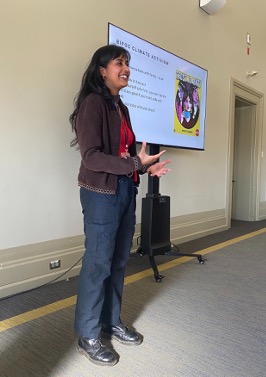
Throughout her career, she’s been a part of various fields as part of her undergrad, but now she’s been using her platform to talk about issues she’s passionate about, such as climate advocacy and informing the general public about the ongoing climate crisis, especially in Peel Region, where most of her work is based. Listening to her presentation made me think about my own journey. Networking is an extremely important asset in any field. Advocacy, especially climate advocacy, without a platform can be difficult—and lonely. It’s hard to tell when and if there are people who have your back when talking about the climate crisis. Joining the Community Climate Council gave me a sense of belonging and allowed me to create meaningful relationships with other like-minded people in order to stir change in our local communities.
My degree is not subject to one specific area, but many. I studied media and communications, but I also studied environmental management, making my work broad across many different streams. I’ve even incorporated a lot of my knowledge from studying the environment into many projects that I’ve worked on for media studies, including creating a paper doll that represents craftivism in a personal meaning for the artist (myself).
If you are unfamiliar with the concept of craftivism, a term coined by Betsy Greer in 2003,¹ it is a form of activism that combines arts and crafts to participate in the act of resistance and protest in opposition to authoritarianism and systematic injustice, including a wide range of social issues such as racism, classism, and feminism. For an alternative media class, combining activism and academics allowed me the opportunity to demonstrate my passion for environmentalism and climate advocacy without being blatantly expressive and defensively scientific.

When it comes to advocacy, the rise of social media, especially within youth and younger communities, can be both powerful and empty, simultaneously. As much as older generations don’t take the youth seriously when it comes to serious issues, the use of social media and art has increasingly become an influential tool of environmental communication. As someone who cares deeply about the state of the environment but struggles to talk about it, I do my best to embed my decisions and behaviour into promoting climate action through smaller choices, as it is more about systematic change than good intentions. Listening to our peers is a small step, but still a start to get others to care. Being a Content Creator with the Community Climate Council allowed me to push boundaries with my studies and work my way into the environmental sector—a field I’ve always seen myself working in and adding meaningful contributions to.
What I’ve learned from being in internet-based spaces to talk about climate is that the environment is a human right. It’s intersectional. There is no definitive branch of the issue that categorizes it into one thing. It’s many things—political, educational, economic, cultural, technological, psychological, scientific, and beyond. The sustainability sector is a place for anyone and any career, even for artists. Environmentalism is also about protecting people, and every decision is a step forward to creating community and peace.


