%20(4).png)

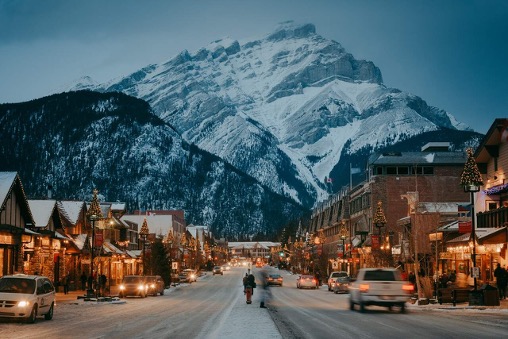
Christmas time in the Rockies, Credit: Yen Ng, 2025
As the holidays arrive, many of us in Canada picture snow-covered streets, glowing windows, and the comfort of our familial festive traditions. This imagery reminds us that home is not only a physical place, but also a feeling rooted in belonging and connection to our environment and the communities we are part of. Yet beneath the warmth of the season lies a tension that suspends in the quiet streets alongside the winter frost. The world around us is changing, and with it, our most cherished traditions are being reshaped by new perspectives and a shifting climate.
Climate change is altering the rhythm of winter across Canada. In Ontario’s north, Indigenous communities such as Weenusk and Attawapiskat First Nation are experiencing warmer temperatures, unstable ice conditions, and shorter winter road seasons (Human Rights Watch, 2020). These changes directly affect access to food and essential supplies, putting additional strain on communities already navigating the legacy of colonial policies. Environmental shifts affect not only physical safety but also emotional well-being and sense of continuity in everyday life (Clayton et al., 2022). When the land changes, so does the relationship people have with place and unpredictable winters increasingly alter how we connect during the holidays.

Humans migrating to what is now North America during the Ice Age, 12600 Years Ago, Credit: Henning Dalhoff, 2016
In this context, home becomes something we sustain through community, creating a sense of belonging that is shaped by shared responsibility. Facing change together draws on a resilience that has carried humanity through ice ages and social upheaval, spanning thousands of years of profound transformation and adaptation (Harari, 2015). National research on community well-being in Canada highlights that strong local connections reduce isolation, particularly during periods of uncertainty (Community Foundations of Canada, 2016; British Columbia Institute of Technology, 2020). With this in mind, we should take a moment to think of Canada’s new immigrant populations who are still adapting to a new sense of normalcy while being faced with social resistance and cultural barriers.
In January 2009, my mother and I immigrated to Nova Scotia from Scotland. I can still remember as a 14-year-old – suddenly an ocean apart from my friends and family – facing temperatures lower than I could have imagined while crippled by fear of the unknown. In those first months, the warm welcome from my new neighbours and community was integral to my survival. I owe thanks to my then-new head teacher, Mr. Higgins, who, on my second day of school, drove to pick me up because I had missed the bus, my mum had already left for work at the hospital, and I couldn’t even point out my location on a map. I also reminisce fondly of weekday evenings spent with the 60-something-year-old couple, Kathleen and Rick, who lived down the road and frequently invited us over to play board games. We’d bundle into our new parkas and traipse through knee-deep snow, eyelashes frozen, because being together was far better than feeling alone.
Grassroots organisations like Community Climate Council create spaces where people can come together and support one another while building connections that make uncertainty and change more manageable. Since climate issues are both social and intersectional, climate action can be a powerful source of belonging. Involvement in fulfilling daily activities has been proven to support mental health while reinforcing personal and collective identity (Schnell and Keenan, 2023). Human adaptation to change emphasizes that agency and participation help our communities to cope with social and environmental stress (Clayton et al., 2022). Rather than diminishing holiday traditions, climate action can offer a renewed sense of purpose by aligning celebration with care for people and place.
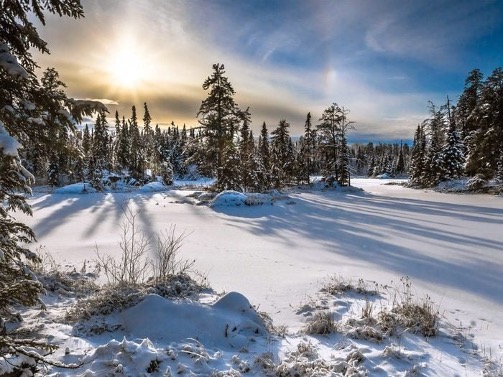
Winter in Thunder Bay, Northern Ontario, Credit: Richard Main, 2025
The winter season is marked in many ways across the country. For some, it is shaped by the giving of gifts, roast turkey, and Frank Capra’s It’s a Wonderful Life, while for others it is a time to honour seasonal cycles, ancestors, and sacred relationships between people and the land. Whether acknowledging Indigenous solstice traditions, Christmas, Hanukkah, Bodhi Day, the Chinese New Year, or simply the opportunity to rest as Earth closes another loop around the sun, we should remember that the holidays are not a single shared story, but a season shaped by many lived experiences. Recognizing these moments creates space for everyone to feel seen and respected, and broadens our understanding of what it means to belong, even in times of tension (Canadian Aboriginal and Minority Supplier Council, 2023).
So as the holidays invite us to pause and reflect, they also call us back to what matters most: community.
Whether it’s checking in on a neighbour or choosing more sustainable ways to celebrate, small actions can be powerful. My friends and family are scattered across the world, but still, to me, community is everything. I find it wherever I go, and I don’t believe that a climate-resilient future is possible without it. So as our world continues to change and we face another winter, let’s embrace each other in our differences and work to strengthen our sense of belonging so that we can continue to build home together – wherever we are.
Here’s to happy holidays and an amazing new year - see you in 2026!
Sources
- British Columbia Institute of Technology. Combat Isolation and Loneliness During the Holidays. BCIT Human Resources, 2020. https://www.bcit.ca/files/hr/pdf/combat-isolation-and-loneliness-during-the-holidays.pdf
- Canadian Aboriginal and Minority Supplier Council (CAMSC). “Recognizing Holiday Celebrations Across Canada’s Diverse Communities.” 2023 https://camsc.ca/recognizing-holiday-celebrations-across-canadas-diverse-communities/
- Clayton, Susan, et al. “Human Responses and Adaptation in a Changing Climate: A Framework Integrating Biological, Psychological, and Behavioural Aspects.” Journal of Environmental Psychology 79 (2022).
https://www.researchgate.net/publication/354238302_Human_Responses_and_Adaptation_in_a_Changing_Climate_A_Framework_Integrating_Biological_Psychological_and_Behavioural_Aspects - Community Foundations of Canada. Vital Signs: National Report. Toronto: Community Foundations of Canada, 2016. https://communityfoundations.ca/wp-content/uploads/2019/08/2016_VS_NationalReport_En_Oct03.pdf
- Human Rights Watch. “‘My Fear Is Losing Everything’: The Climate Crisis and First Nations’ Right to Food in Canada.” October 21, 2020.https://www.hrw.org/report/2020/10/21/my-fear-losing-everything/climate-crisis-and-first-nations-right-food-canada
- Schnell, Tatjana, and William J. F. Keenan. “Sense of Belonging, Meaningful Daily Life Participation and Well-Being: An Integrated Investigation.” Frontiers in Psychology 14 (2023). https://www.researchgate.net/publication/368858102_Sense_of_Belonging_Meaningful_Daily_Life_Participation_and_Well-Being_Integrated_Investigation


